

Reviewed by
Jarrett Dottin
Licensed Occupational Therapist dedicated to helping others live their best lives. Certified lymphedema therapist and amazon affiliate who has tested over 1,000 different products. About JD →
As an Amazon Associate I earn from qualifying purchases. Some links on this site are affiliate links, if you buy though them I may make a commission at no extra cost to you.
Quick Verdict
Two stackable boxes, twelve heavy-duty vacuum bags, and one rechargeable pump designed specifically for filament storage, sealing a spool tighter than I ever managed by hand. If your prints keep failing on stringing and clogs, this is aimed squarely at the moisture that’s causing it.
Buy if you:
- Print regularly and burn through PLA, PETG or TPU spools
- Live somewhere humid and keep chasing stringing and clogs
- Have 12+ spools and want them stacked instead of scattered
- Want an auto pump so you actually reseal bags every time
Skip if you:
- Hate remembering to recharge a small pump before every seal
- Only own two or three spools and rarely print
- Want a heated drying box, not passive moisture blocking
Clicking takes you to the seller's website. We may earn a small commission if you purchase, at no extra cost to you.
| Kit contents | 2 storage boxes, 12 vacuum bags, 1 auto pump |
|---|---|
| Capacity | Up to 6 spools per box, 12 total |
| Spool size fit | 200g to 1kg standard spools |
| Material compatibility | PLA, ABS, PETG, TPU and more |
| Box material | Oxford cloth with clear front window |
| Bag material | PA+PE puncture-resistant |
Protect Your Prints: Smart Filament Storage Solutions
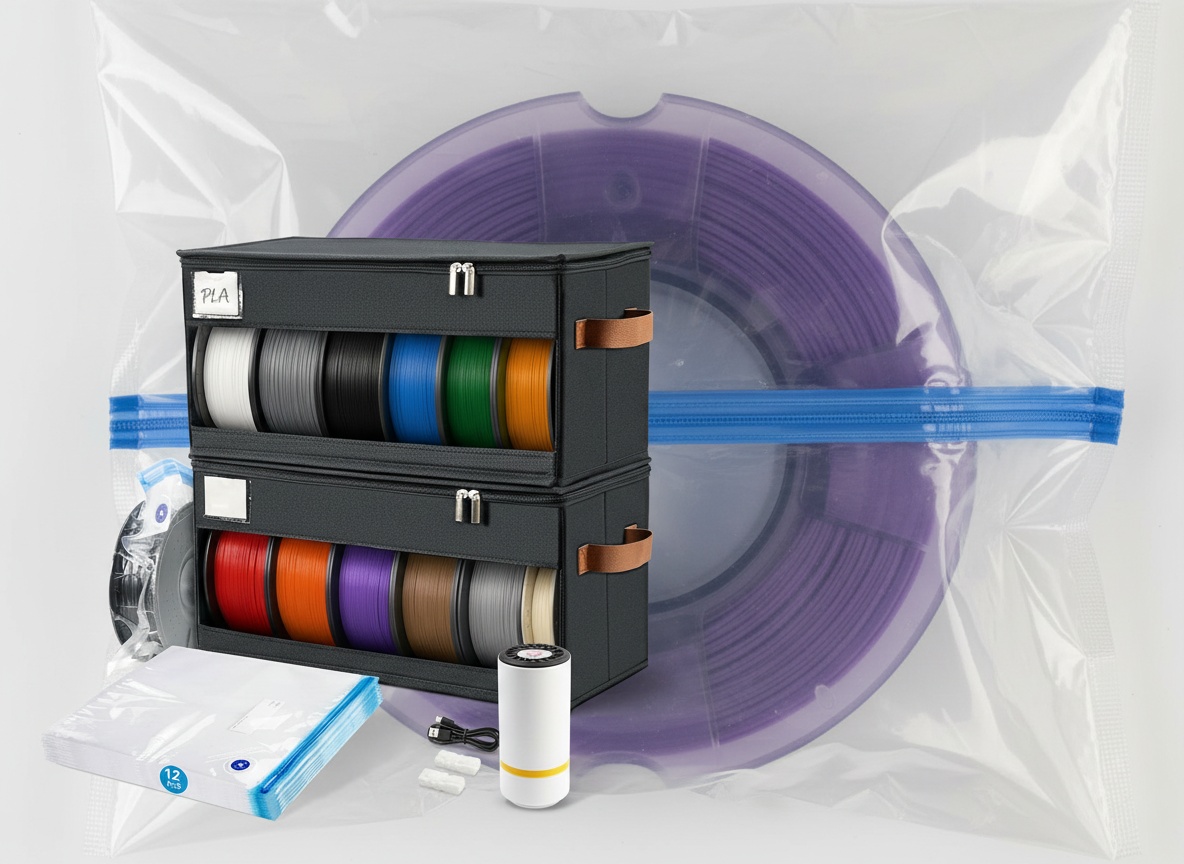
Moisture is the quiet killer of 3D printing. Filament pulls humidity out of the air, and once it’s saturated you get stringing, clogs, popping sounds, and layers that just won’t bond. This filament storage kit tackles that head-on with two dry boxes, twelve vacuum bags, and an auto pump that sucks the air out for you. When my desiccant packs stopped showing blue and my PLA started popping mid-layer, I realized the loose-bag routine wasn’t cutting it anymore.
The catch isn’t knowing you should seal filament, it’s actually doing it every time. The reason they don’t is friction. Loose bags disappear, manual seals never hold, and desiccant packs get forgotten in a drawer. A kit that removes that friction is the whole pitch here.
What’s Actually In The Box
You get two stackable Oxford cloth boxes, each rated for six standard 1kg spools, so twelve spools total. Add twelve heavy-duty PA+PE vacuum bags and one rechargeable auto pump, and that’s the full kit. No separate tools, no hunting for a vacuum cleaner attachment.
The boxes have a clear front window so you can eyeball spool colors and types without unzipping anything. Each one has a reinforced side handle, and when you’re not using them they fold flat. That last detail matters more than it sounds if your bench is already crowded. The bags themselves are the thick, puncture-resistant kind, which is the right call because sharp filament ends love to tear cheap plastic.
The Auto Pump Is The Part That Sells It
The pump cuts sealing time from two minutes to ten seconds. That gap is the whole behavior change, at ten seconds, resealing after every print session stops feeling like a chore and starts being the thing you just do. That consistency is what protects the filament, not the bag itself.
A spool sealed in one of these bags collapses the plastic tight against the filament, blocking air, dust, and UV light. The dual approach, box plus vacuum bag, is smart layering. The bag does the airtight work; the box keeps everything organized, dust-off, and stackable on the shelf. It fits spools from 200g up to a full 1kg, so odd sample rolls and full production spools all live in the same system.
The Pump Needs Charge, And That’s The Catch
The rechargeable pump is the convenience and the catch in one part. It’s the reason you’ll seal bags consistently, but it’s also one more thing that needs battery before it works. Reach for it on a dead charge and you’re stuck waiting, or back to manually pressing air out through the valve. If you’re the type who forgets to charge things, park it on a cable near your printer so it’s always ready.
The other limitation: this is passive moisture protection, not active drying. Vacuum bags stop new humidity from getting in, but if your filament was already wet when you sealed it, the bag locks that moisture in with it. Dry the spool first, then seal. This kit keeps good filament good; it doesn’t rescue filament that’s already soaked.
Get it now
Filament Storage Box With Auto Pump
Get the best price on Amazon →As an Amazon Associate I earn from qualifying purchases. Some links on this site are affiliate links, if you buy though them I may make a commission at no extra cost to you.

Who This Filament Storage Kit Makes Sense For
The sweet spot is twelve or more spools in a humid room. If you’re printing weekly and chasing the same stringing problem across three different PLA brands, the common thread is usually storage, not settings. Twelve vacuum-sealed spools stacked on a shelf is a fundamentally different situation than a pile of half-open bags on the bench.
PLA, ABS, PETG, and TPU users all benefit, but TPU and PETG folks especially, since those materials are thirstier for moisture and quicker to ruin a print. If you only own two or three spools and print once a month, the kit is more system than you need. This shines when you’ve got volume to manage.
Vacuum Bags Versus A Heated Dry Box
This is storage, not a drying appliance, and that distinction decides whether it’s right for you. A heated filament dry box actively bakes moisture out and often lets you print directly from it. This kit doesn’t do that; it keeps already-dry filament dry between prints.
For most people, that’s the smarter buy. Heated boxes are pricier, hold fewer spools, and only protect what’s inside them right now. Twelve vacuum-sealed spools cost less to store and free up your heated box for the one spool you’re printing today. The two tools solve different problems. If you print constantly and want dry-while-printing, get a heated box too. For everything sitting on the shelf waiting its turn, this kit is the better value.
How To Get The Most Out Of It
Dry your filament before you seal it. Toss a desiccant pack into each bag if you have them, seal with the auto pump, and only then stack the boxes. Label the clear windows if your colors look similar under shop lighting. And keep the pump charged and within reach, because a sealing tool you have to go find is a sealing tool you’ll skip.
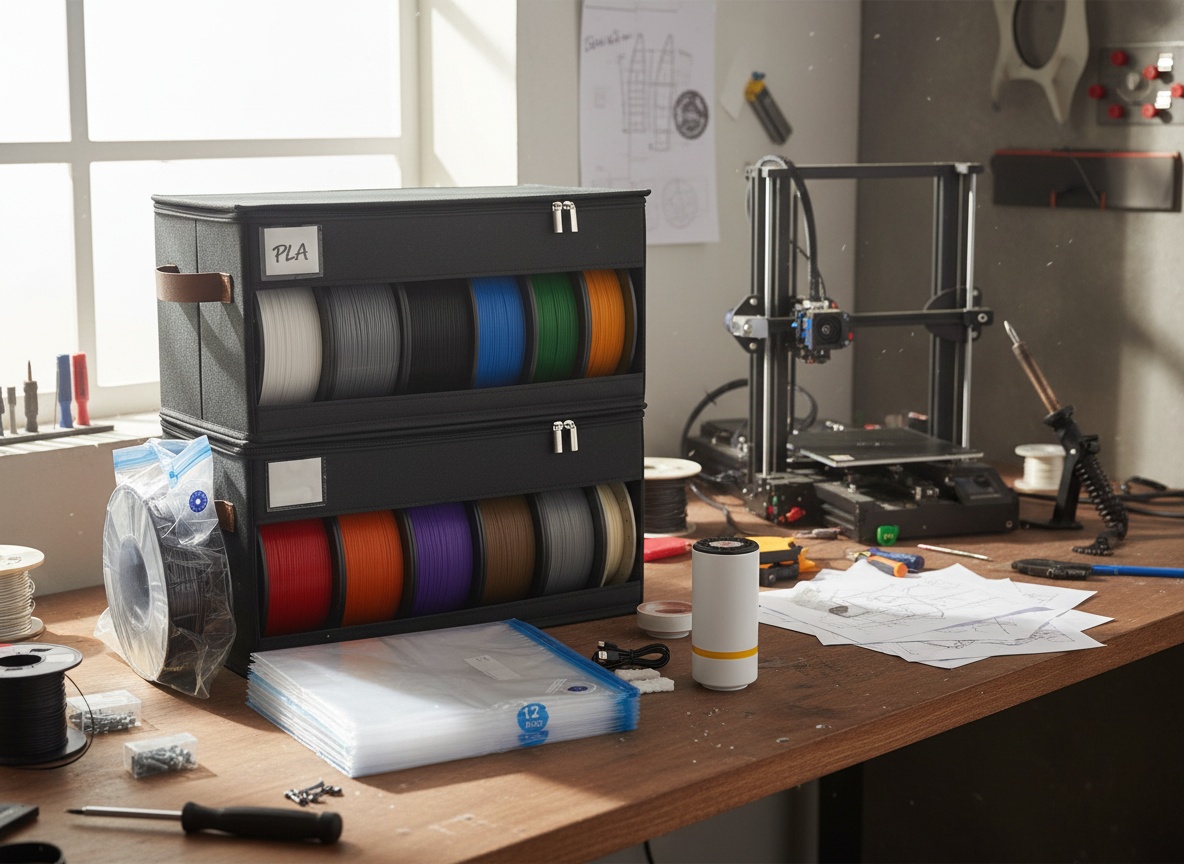
One more tip: the boxes fold flat, so if you’re only using a few spools right now, collapse the second box and store the spare bags with it. No reason to give up bench space for empty containers.
Pros
- Auto pump seals bags fast, so you actually reseal every time
- Two boxes hold 12 spools total and stack to save bench space
- Clear front windows let you spot colors without unzipping
- Heavy-duty PA+PE bags resist tears from sharp filament ends
- Fits everything from 200g samples to full 1kg spools
Cons
- The pump needs recharging, and a dead battery stalls you
- Passive storage only, it won’t dry filament that’s already wet
- Overkill if you only own a few spools and rarely print
Frequently Asked Questions
Does this filament storage kit actually keep moisture out?
Yes, the vacuum bags create an airtight seal that blocks humidity, dust, and UV light from reaching your spools. The catch is it protects already-dry filament, so dry your spools before sealing them.
How many spools does it hold?
Twelve total, six per box across the two boxes. Each slot fits standard spools from 200g up to a full 1kg, so you can mix sample rolls and production spools in the same system.
Do the vacuum bags work with a regular vacuum, or do I need the pump?
The included rechargeable auto pump is designed for these bags and pulls air out faster and tighter than manual methods. Most valve-style bags also accept manual pressing if the pump ever dies, but the pump is the point of the kit.
Can I print directly from these boxes?
No, these are storage containers, not feed-through dry boxes with a filament port. Pull the spool out to print, then reseal it in the bag afterward. If you want dry-while-printing, pair this with a heated dry box.
Will it fit non-standard or oversized spools?
It’s sized for standard 200g to 1kg spools and fits most common brands. Unusually wide or tall spools may be a tight squeeze, so check your spool dimensions against the listing if you run oddball sizes.
Do I need desiccant packs too?
Not strictly, since the vacuum seal removes most of the air, but tossing a desiccant pack in each bag adds a second layer of protection. It’s cheap insurance for filament that sits sealed for months.
How do I store the boxes when they’re empty?
They fold flat when not in use, so an empty box collapses down for compact storage. That’s handy if you’re only running a few spools and don’t want an empty container eating bench space.
Is this worth it if I only print occasionally?
If you print once a month with two or three rolls, skip it, a two-pack of standalone vacuum bags costs a fraction of this and does the same job at that scale. The kit earns its price when you’ve got eight or more spools rotating in and out, because that’s when the organization and the auto pump stop being a luxury and start saving you a ruined print.
Get it now
Filament Storage Box With Auto Pump
Get the best price on Amazon →As an Amazon Associate I earn from qualifying purchases. Some links on this site are affiliate links, if you buy though them I may make a commission at no extra cost to you.
About the reviewer
Jarrett Dottin
Licensed Occupational Therapist dedicated to helping others live their best lives. Certified lymphedema therapist and amazon affiliate who has tested over 1,000 different products.